

Traffic Management in Australia: The Complete Guide to Systems, Strategies & Plans
Traffic congestion costs the Australian economy more than $10 billion a year in lost productivity and wasted fuel, and that figure is projected to climb toward $38–39 billion annually by 2031 without major intervention, according to Infrastructure Australia and iMOVE Australia. Sydney and Melbourne drivers each lose an average of $4,500+ a year to delays and fuel, and outer-suburban commuters in both cities spend around 41% of their commute stuck in traffic, roughly 77 hours, or two working weeks, every year.
For councils, contractors, and businesses across Australia, that's not an abstract economic statistic; it's lost crews, missed delivery windows, and rising risk on every job site and road network. That's where traffic management comes in.
In this guide, CRG Traffic Management breaks down what traffic management actually is, the strategies used across Australian roads and work sites, how to build a compliant traffic management plan, and where the industry is heading next.
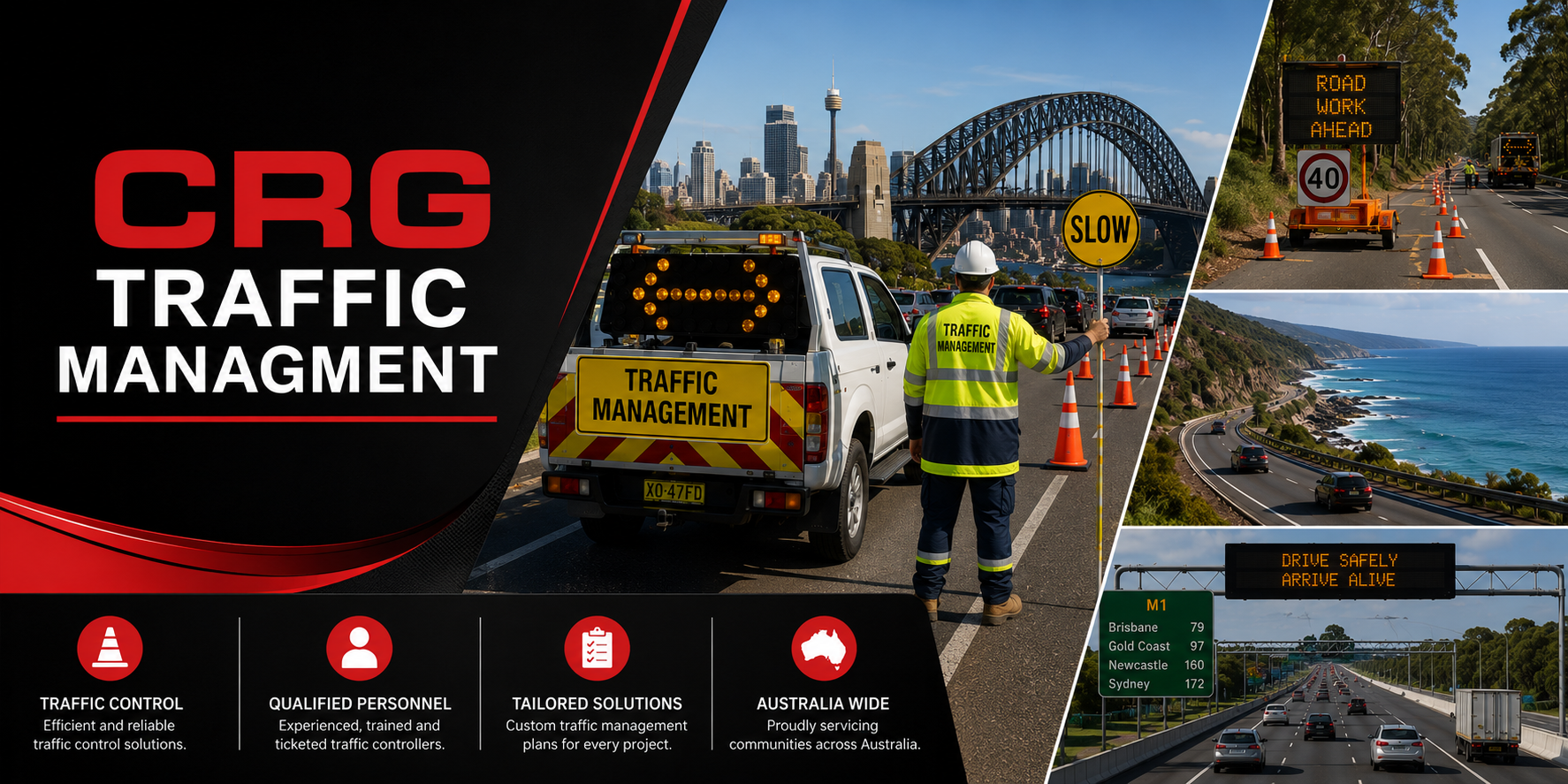
What Is Traffic Management?
Traffic management is the process of planning, monitoring, and controlling the movement of vehicles, pedestrians, and cyclists to keep roads, work zones, and event sites safe and efficient. It combines infrastructure design, technology, signage, and real-time monitoring to reduce congestion, prevent accidents, and keep traffic moving smoothly.
At its core, effective traffic management does three things:
Reduces congestion by optimising how vehicles move through a network
Improves safety for drivers, cyclists, pedestrians, and on-site workers
Supports compliance with Australian Standards and state road authority requirements
Traffic Management vs. Traffic Control vs. Traffic Guidance Schemes
These terms get used interchangeably across Australian job sites, but they mean different things, and knowing the difference matters for compliance.
Traffic management is big-picture planning and strategy aimed at optimising flow across an entire network. It's long-term and systemic, think a state-wide signal coordination program.
Traffic control is the tactical use of signs, signals, and traffic controllers to direct traffic in the moment. It's immediate and situational: stop/slow bats, traffic controllers, and temporary signals on the ground.
A Traffic Guidance Scheme (TGS) is a site-specific diagram showing the layout of signs, barriers, and devices for a particular worksite, for example, the lane closure layout for a road resurfacing job.
A related document, the Traffic Management Plan (TMP), is broader still; it wraps the TGS together with risk assessments, public communication, and incident response, and is typically required by the relevant state road authority (e.g. Transport for NSW, Department of Transport and Planning Victoria, TMR Queensland) for higher-risk or higher-impact works.
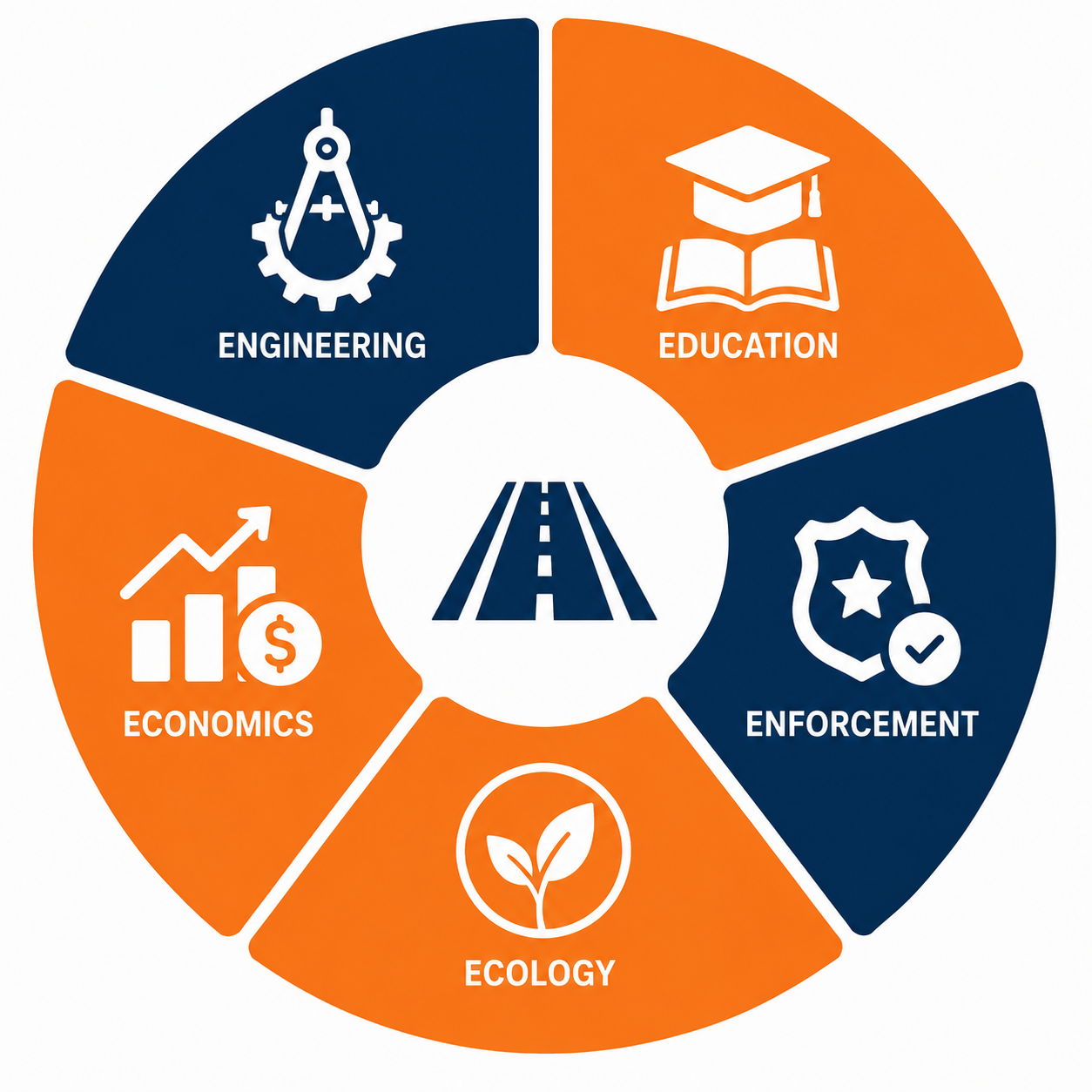
The 5 Core Pillars of Traffic Management
Every well-run traffic management program rests on five pillars:
Traffic Engineering — Designing roads, intersections, signals, and signage to physically support safe, efficient flow.
Traffic Education — Public awareness campaigns, driver training, and road safety programs that shape behaviour before it becomes a problem.
Traffic Enforcement — Speed monitoring, citations, and checkpoints that keep regulations meaningful.
Traffic Ecology — Reducing emissions and environmental impact through smarter routing, active transport, and green infrastructure.
Traffic Economics — Recognising that congestion has a direct cost to local business productivity and freight road freight volumes in Australia are projected to rise 77% by 2050, making efficient traffic flow an economic priority, not just a safety one.
Key Traffic Management Strategies & Technologies
Modern traffic management leans heavily on Active Traffic Management (ATM) systems that respond to real-time conditions rather than fixed schedules. Many of these strategies are detailed in the Austroads Guide to Traffic Management, the primary reference for traffic engineering and control practice across Australia and New Zealand. Here's how the main strategies work:
Adaptive Ramp Metering (ARM) — Signals control how many vehicles enter the freeway. Best suited to high-volume motorway on-ramps, it smooths merging and reduces bottlenecks.
Adaptive Traffic Signal Control (ATSC) — Adjusts signal timing based on real-time queue data. Used on arterial roads and intersections, it cuts travel time and shortens queues.
Dynamic Junction Control (DJC) — Reallocates lane access at busy interchanges with variable demand, reducing delays and increasing travel speeds.
Dynamic Lane Reversal (DLR) — Reverses lane direction based on demand on commuter corridors, bridges, and tunnels, increasing throughput.
Dynamic Lane Use Control (DLUC) — Opens and closes individual lanes with driver warnings during incidents or peak periods, improving merge safety and reducing secondary crashes.
Dynamic Shoulder/Emergency Lane Use — Activates the shoulder as a travel lane during peak-hour motorway congestion, reducing travel time and crash severity.
Queue Warning (QW) — Displays real-time alerts ahead of slowdowns in areas of rapidly changing congestion, cutting rear-end collisions.
Dynamic Speed Limit (DSpL) — Adjusts posted speed limits to real-time conditions on weather-sensitive roads or school zones, smoothing flow and reducing speed variability.
Dynamic Merge Control (DMC) — Manages vehicle entry into merge zones with advisory messages in work zones and lane closures, creating safer merge gaps and fewer rear-end collisions.
Real-World Results in Australia
These strategies aren't theoretical; Australian road authorities have measured their impact directly:
M1 Pacific Motorway, Queensland and CityLink/Tulla Widening, Melbourne, have both used managed motorway technology combining ramp metering, variable speed limits, and lane use management signs to smooth peak-hour flow without adding physical lanes.
Sydney's M4/M5 motorway upgrades have incorporated variable message signs and incident detection systems to reduce secondary crashes and clear incidents faster.
Internationally comparable ATM deployments combining lane control, dynamic speed limits, merge control, and queue warning together have shown 2–6% improvements in weekday travel times outside peak hours, a benchmark that Australian managed motorway programs are increasingly tracking against.
Ramp metering has one of the strongest track records of any single intervention, with some long-running international programs reporting benefit-to-cost ratios as high as 15:1, a model several Australian states have adapted for their managed motorway frameworks.
How to Develop a Traffic Management Plan (Step-by-Step)
Whether you're managing a construction site, a special event, or a stretch of road, building a compliant traffic management plan in Australia follows a similar process:
Conduct a traffic impact assessment. Identify expected volumes, peak times, road classification, and existing problem areas.
Map site access, parking, and pedestrian routes. Define how vehicles, cyclists, and pedestrians will move in, through, and around the site.
Prepare a Traffic Guidance Scheme (TGS). Select signage, barriers, signals, and devices in line with AS 1742.3 (traffic control for works on roads) and your state road authority's supplements.
Build an incident and emergency response plan. Define detours, communication protocols, and emergency service access before you need them.
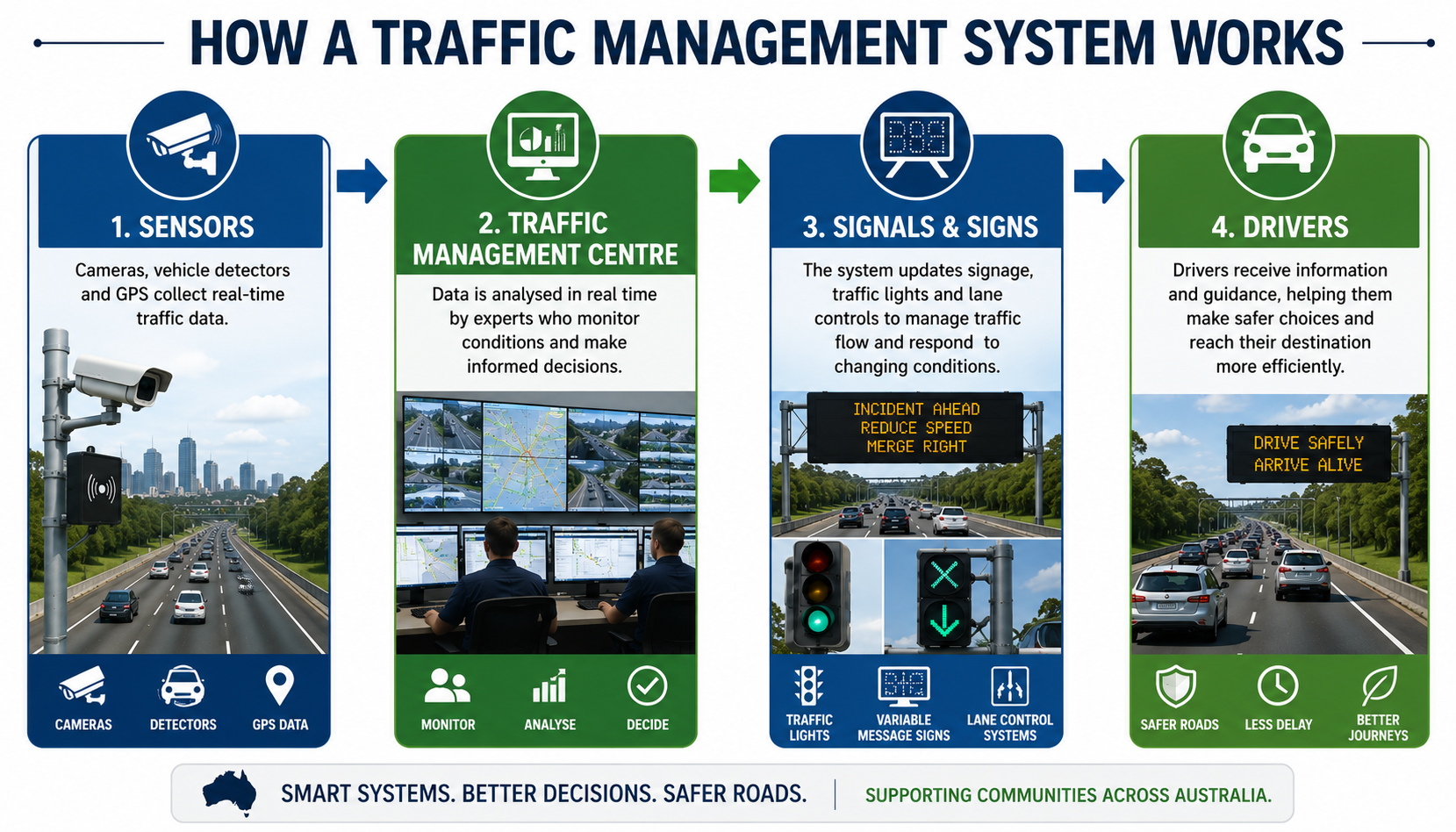
Set up monitoring. Use sensors, CCTV, or qualified traffic controllers to track real-time conditions and adjust on the fly.
Review, test, and secure approvals. Confirm the plan meets relevant Australian Standards and gets sign-off from the local council or state road authority before mobilisation.
Tips from CRG Traffic Management: Separating the Traffic Guidance Scheme (the physical layout) from the broader risk and communications plan tends to speed up council and road authority approvals, because reviewers can assess compliance and community impact independently.
Standards & Compliance in Australia
Traffic management in Australia is governed primarily by the Austroads Guide to Traffic Management (13 parts, covering everything from theory and transport studies through to local street management and the Safe System approach) and the AS 1742 series of Australian Standards, particularly AS 1742.3 for traffic control at worksites.
On top of these national references, every state and territory road authority, Transport for NSW, Department of Transport and Planning (VIC), Transport and Main Roads (QLD), Main Roads WA, Department for Infrastructure and Transport (SA), and other layers its own supplements, accreditation requirements (such as RMS/TfNSW traffic control accreditation), and permit processes. Getting a Traffic Guidance Scheme approved usually means meeting both the national standard and the specific state authority's requirements.
Working with a team that understands both the Austroads/AS 1742 framework and local state nuances like CRG Traffic Management helps avoid delays, rejected permits, and liability exposure.
The Future of Traffic Management in Australia
A few shifts are already reshaping the industry locally:
Managed motorways. States are increasingly favouring "smart" technology ramp metering, variable speed limits, lane use signs over costly new lane construction, partly in response to research showing new lanes induce demand rather than solve congestion long-term.
AI-driven prediction. Systems are moving from reactive to predictive, flagging bottlenecks before they form rather than responding after the fact.
Connected and autonomous vehicles (CAVs). As more vehicles communicate directly with road infrastructure, expect more precise routing and cooperative collision avoidance on Australian roads.
Demand management. With freight volumes on Australian roads projected to keep rising, expect growing investment in active transport, public transit, and flexible work arrangements alongside traditional infrastructure.
Need a Traffic Management Plan You Can Trust?
CRG Traffic Management designs, implements, and manages compliant traffic plans for construction sites, events, and roadways across Australia built to Austroads and AS 1742 standards and tailored to your state's specific requirements. Contact CRG Traffic Management to talk through your next project.